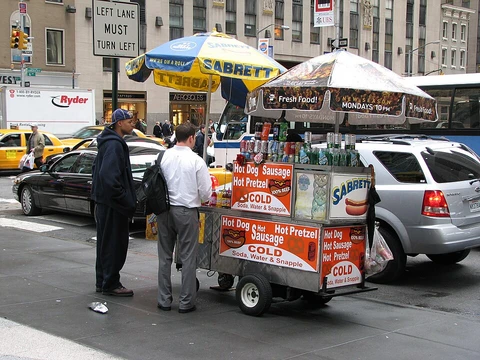
Gyro (food)
Greek dish of vertical-rotisserie meat served in pita.

Gyros (or gyro) is a Greek dish consisting of meat cooked on a vertical rotisserie, sliced, and served wrapped or stuffed in pita bread with ingredients such as tomato, onion, fried potatoes, and tzatziki. The name comes from the Greek γύρος ('turn'), a calque of the Turkish döner. It became a popular fast food in Athens and in cities like Chicago and New York by 1970, and mass production in the United States began in the early 1970s by Greek-descended entrepreneurs in the Chicago area.
- Origin
- Greece (with roots in Ottoman Bursa and Asia Minor)
- Main meat (Greece)
- Pork (chicken occasionally used)
- Main meat (other countries)
- Ground beef and lamb, or chicken
- Key ingredients
- Pita, tomato, onion, fried potatoes, tzatziki
- Earliest US mention
- By at least 1970 in American English
- Related dishes
- Shawarma, donair, al pastor (all derived from Turkish doner kebab)
Lore & Background
Gyros traces its technique to 19th-century Bursa in the Ottoman Empire, where meat was grilled on a vertical spit and sliced as it cooked. Following World War II, gyros made with lamb appeared in Athens, likely introduced by immigrants from Anatolia and the Middle East. The Greek version is normally made with pork and served with tzatziki, and became known as gyros. By 1970, gyros wraps were already a popular fast food in Athens, as well as in Chicago and New York City. At that time, vertical rotisseries were starting to be mass-produced in the US by Gyros Inc. of Chicago, though the stacks of meat were still hand-made. Several claimants of Greek descent, all based in the Chicago area in the early 1970s, have said they introduced the first mass-produced gyros to the United States. One, Peter Parthenis, stated that the mass-produced gyro was first conceptualized by John and Margaret Garlic; John Garlic was a Jewish car salesman who later ran a restaurant featuring live dolphins. The Halifax donair in Canada, based on the Greek gyros, was invented in the 1970s by Peter Gamoulakos, originally from Greece, who sold Greek gyros from his restaurant off the Bedford Highway.
Reader's Guide
It became a staple of Greek fast food and spread internationally, particularly to the United States and Canada, where it was adapted with mass-produced meat cones and local variations like the Halifax donair. The dish illustrates how immigrant communities preserve and transform traditional foods: Greek entrepreneurs in Chicago pioneered mass production in the early 1970s, while in Greece, gyros remains distinct from souvlaki and kalamaki depending on region. The name itself—a calque of the Turkish döner—was adopted to replace the Turkish-derived ντονέρ, highlighting the role of language in national identity. Gyros also exemplifies the global diffusion of vertical-rotisserie cooking, linking it to shawarma, donair, and al pastor. Its legacy lies in its widespread popularity as a convenient, flavorful street food, and in the ongoing debates over its name and preparation methods across different cultures.
Did You Know?
- The name 'gyros' is a calque of the Turkish 'döner', both meaning 'turn'.
- In Greece, gyros is traditionally made with pork, while chicken is occasionally used as an alternative.
- By 1970, gyros wraps were already a popular fast food in Athens, Chicago, and New York City.
- The Halifax donair in Canada, based on the Greek gyros, was invented in the 1970s by Peter Gamoulakos.
Frequently Asked Questions
What exactly is a gyro (food)?
A gyro is a Greek street-food dish made by slicing meat off a vertical rotisserie and serving it in or on pita bread alongside tomato, onion, fried potatoes, and tzatziki sauce. The name is a calque of the Turkish word döner, both meaning 'turn,' which describes the spinning cooking method.
Where did the gyro originate, and what meat is traditionally used in Greece?
The dish traces its roots to Ottoman Bursa and Asia Minor before becoming a staple of Greek street food. In Greece, pork is the classic meat for gyros, though chicken is sometimes offered as an alternative.
How did the gyro become a popular fast food in the United States?
By the 1970s, gyro stands had become a recognizable part of the fast-food scene in cities like Chicago and New York. Mass production in the U.S. kicked off in the early 1970s, driven largely by Greek-descended entrepreneurs operating out of the Chicago area.
What is the difference between a gyro and shawarma or al pastor?
All three are vertical-rotisserie meat dishes that ultimately descend from the Turkish döner kebab tradition. The gyro is the Greek adaptation (typically pork in Greece, ground beef/lamb or chicken elsewhere), while shawarma, donair, and al pastor are the regional variants found in the Middle East, Turkey, and Mexico respectively.
What are the key components that make up a classic gyro wrap?
A standard gyro consists of thinly sliced rotisserie meat wrapped in pita bread with tomato, onion, fried potatoes, and a dollop of tzatziki. These five elements—meat, pita, tomato, onion, and tzatziki—form the recognizable core of the dish across most preparations.
More in Street Food 1-20
Spotted an error? Know more?
This is a living reference — every entry is fact-audited, and reader corrections feed straight into our audit queue. Suggest an edit · See this site's audit record